
A Rough Overview of Space Concepts across Architecture and Mathematics
This article outlines how the concept of space differs in architecture and mathematics, offering insights for architects
The term space is used in both architecture and mathematics (geometry).
However, the two disciplines do not necessarily refer to the same thing when they use this word.
The purpose of this paper is not to dismiss this discrepancy as a misuse of terminology or a lack of understanding, but rather to clarify what space is centered on in each discipline—what each field takes as its primary concern when employing the term. 1
When architectural practitioners engage with geometry, or read mathematically framed explanations, a lack of awareness of this discrepancy can lead to discussions that fail to align.
In the following sections, while keeping assumptions to a minimum, the meanings of space in architecture and mathematics are presented in a comparative manner.
Space in Architecture: Space as Experience
In an architectural context, space generally refers to an area that is enclosed or articulated by elements such as walls, floors, ceilings, and partitions. 2
It is reasonable to refer to such enclosed areas as interior space, and to the surrounding area beyond them as exterior space.
A defining characteristic of this type of space is that people can move within it, remain in it, and perform actions.
This stands in contrast to solid regions—such as the interior of walls or floors—where such activities are not possible.
Architectural space comes into being only through material elements such as wood, concrete, and glass.
However, space itself is not a material entity.
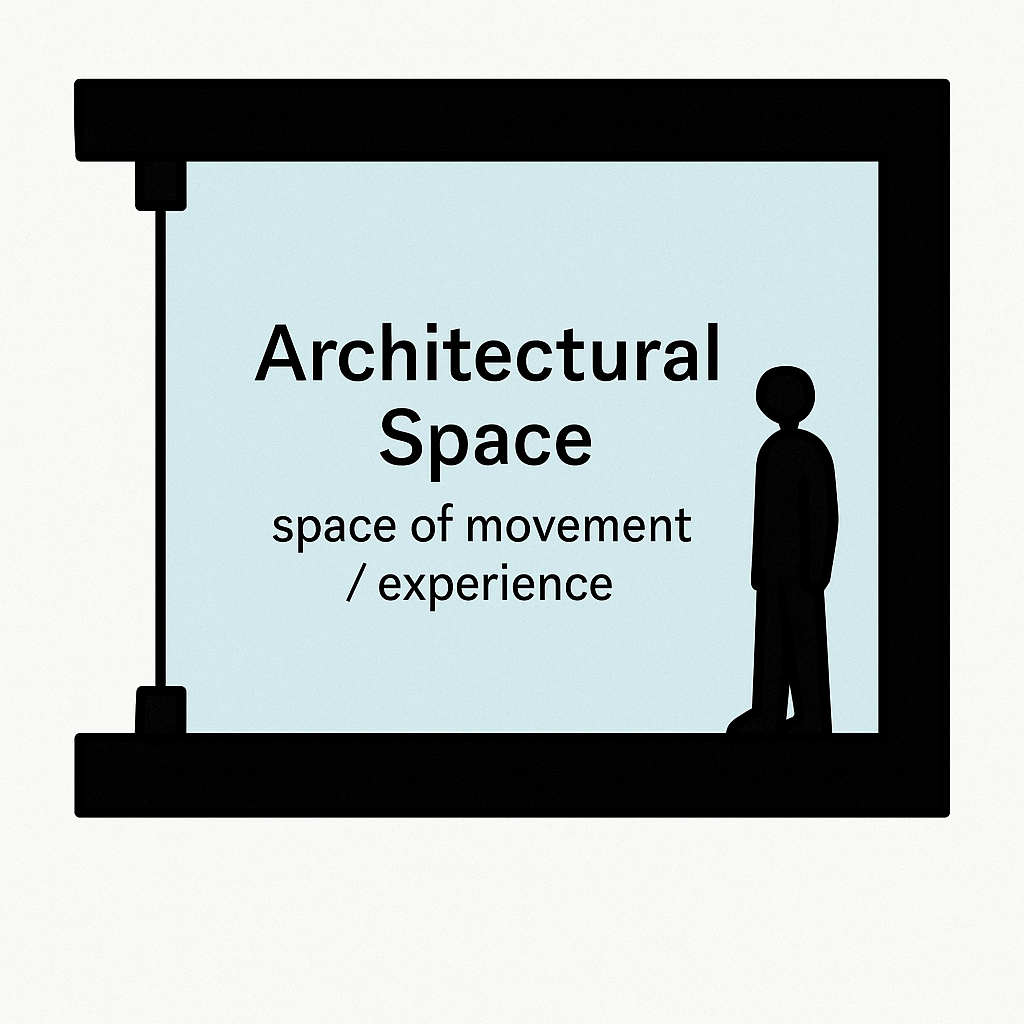
Rather, it is a conceptual aggregation of experiences that are perceived by people and shared with others. 3
In other words, architectural space is supported by material substances, yet it emerges at a different level from the materials themselves.
Space in Geometry: Space as Structure
In contrast, when space is discussed in mathematics, including geometry, it carries a fundamentally different meaning.
For example, water is an aggregate of H2O molecules.
Water exists as a coherent liquid not merely because molecules are gathered together, but because intermolecular forces—such as hydrogen bonding—create relationships among them.
In a similar way, mathematical space begins with a set of elements, to which rules such as distance or neighborhood are assigned.
This allows relationships among elements—such as closeness, connectivity, or continuous change—to be formally handled. 4
The elements in question, however, are not material particles; they are entirely abstract entities.
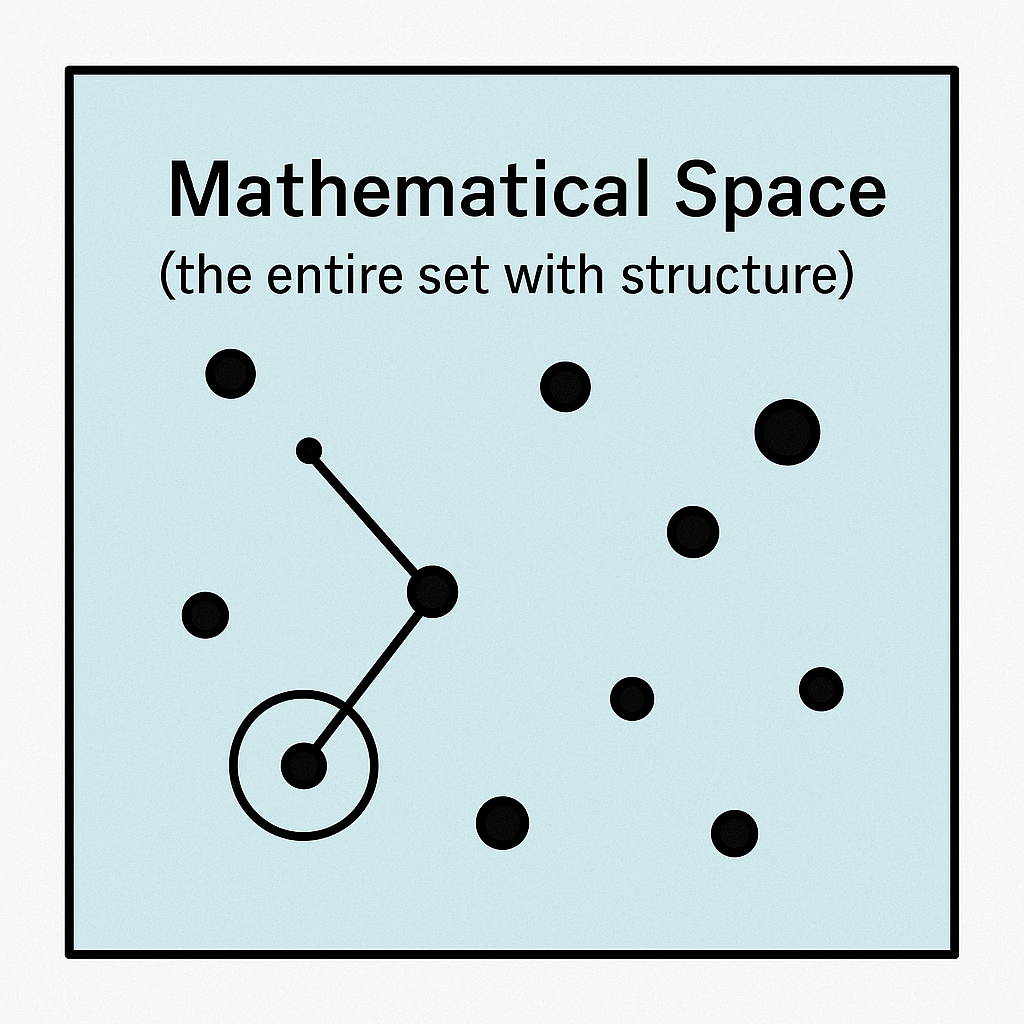
What is crucial here is that mathematical space is defined independently of material substance.
Whether a human can exist within it, move through it, or experience it is not a prerequisite.
In mathematics, space serves as a framework that enables reasoning and computation.
Depending on the structure imposed, it becomes possible to measure distances, define proximity, or describe continuous transformations.
Where the Discrepancy Lies
From this perspective, the discrepancy between architectural and mathematical notions of space is not merely a matter of linguistic confusion.
Although the same word is used, each discipline places something different at its center.
In architecture, space is centered on human experience, action, and occupation.
In mathematics, space is centered on structures such as distance, neighborhood, and continuity.
Architectural space depends on material in order to support experience.
Mathematical space, by contrast, is abstracted away from material in order to handle structure.
For example, the theoretical foundation of NURBS—historically used in architecture to represent curved surfaces—rests on a mathematical conception of space. 5
When curved geometry becomes the basis for discussions of architectural space, it is essential to recognize and distinguish these two contextual frameworks.
How to Read This Discrepancy
The key point is not to determine which usage of space is correct, but to understand that the term plays different roles in different disciplines.
Architecture employs the concept of space to organize human experience.
Mathematics employs the concept of space to handle structure.
Even when the same word is used, its meaning changes depending on what is placed at the center.
In practice, this discrepancy often does not surface as a major problem, because the roles of designers and engineers implicitly separate these contexts.
Nevertheless, if one seeks further development in architectural form-making through the introduction of mathematical frameworks, this conceptual clarification becomes practically valuable.
Conclusion
This paper has outlined the discrepancy between architectural and geometrical notions of space with minimal assumptions.
The source of the discrepancy lies not in the degree of specialization, but in what each discipline takes as the foundation of its conceptual framework.
Footnotes
-
This paper focuses primarily on architectural design practice and its associated educational and technical contexts. It does not aim to provide a comprehensive treatment of philosophical theories of space or the foundations of mathematics. ↩
-
The understanding of space presented here reflects usages widely shared in contemporary architectural practice, and is not intended to represent semiotic, institutional, or urban-theoretical concepts of space. ↩
-
While this view aligns with positions discussed in phenomenological architectural theory and environmental behavior research, the present paper does not rely on any specific theoretical system and remains at the level of practical understanding. ↩
-
In mathematics, there also exist spaces without distance, or spaces defined by more abstract structures. In order to clarify the contrast with architecture, this paper focuses on spaces characterized by structures such as distance and neighborhood. ↩
-
NURBS are cited here as a representative case where the two notions of space connect in practice; no attempt is made to discuss their theoretical details. ↩